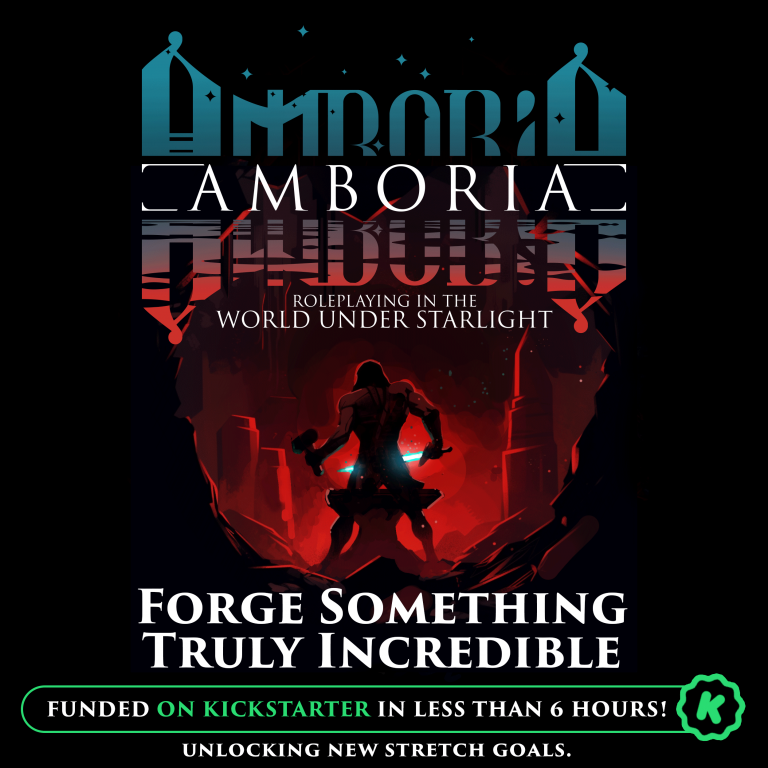
Amboria: Roleplaying in the World Under Starlight is a game of magic, high adventure, and culture creation. Set in a world two decades in the making, Amboria introduces players to a rich tapestry of liturgy, lore, romance, and history which draw deeply from the well of legends and folklore of eastern Europe and the Black Sea region. In this world, players take on the role of Adventurers: courageous individuals on the edges of the kingdom who journey into the dark, fight monsters, and uncover the secrets and treasures of their own past in an attempt to build communities that will stand against the coming night.
The Ambori are the people of Sky, Forest, and Water. They trace their lineage back to Lanenomen, the last of the lords of Starland, and thence to Feihoth himself, the first star to glimmer in the Western sky. When Sencan built his city amid the sacred grove of cypress trees that surrounded the holiest of all hills, he established a kingdom and lineage which would last the ages.
For three eons of the world the heirs of Sencan reigned, their legitimacy unquestioned as long as they held the Hurorupeim—the living sword which Sencan forged long ago in the deep places of the earth, which would serve no master but him.
But thirty years ago, the Hurorupeim was lost. Now, in the year 451 of the Third Eon, the cruel King Onwae sits the throne, and many fear that the line of Sencan is failing at last. Beasts strange and fell stalk the northern moors; around the cities of the Archipelago, strange horrors with many eyes hunt the Deep Men once again.
In these uncertain days, the hardy folk at the kingdom’s edges do not look to the royal city for deliverance. They must find strength—if they are to find it at all—from among themselves.
What’s This Game About?
This game—like the literature, poetry, and rituals I’ve been developing for the last two decades—focuses on a specific nation and culture: that of the Ambori, the “Children of Water and Starlight.” The Ambori are originally a composite people, an alloy forged from the union of two ancient heroic peoples and tried in the fires of slavery and persecution. 1800 years ago (at the beginning of the period covered in this game), a leader known as Sencan the Great forged a living sword and led his people to freedom, founding a city and establishing a dynasty. At the time that Amboria: Roleplaying in the World Under Starlight begins, Sencan’s dynasty and the kingdom he built is beginning to unravel. Players take on the role of Adventurers and are presented with the choice to either selfishly profit from these dark times, or build communities that have a chance of surviving the coming storm.
Amboria: Roleplaying in the World Under Starlight is a game of high adventure. Heroes are expected to be heroic, and their rise to glory (or fall into ruin) is expected to be spectacular and dramatic, impacting the lives and communities they touch along the way. Adventurers fight monsters, uncover ancient treasures, and find themselves thrust into the crossfire of political machinations by people who want to use their power and influence to their own ends. Magic exists in the World Under Starlight in a myriad of forms, however it is unlikely to manifest in the kind of big, showy ways that have become popular in high-fantasy roleplaying games. On the other hand, it can still be just as powerful and dangerous: the investigation of an old ruined tower from a previous age might bring Adventurers into contact with an older, much more scarred version of themselves; and eating food offered by a grizzled traveler in some wayside ruins might result in waking up in a different time and place. Magic is never mechanical, seldom predictable, and always wondrous.
Amboria is also a game of culture creation. Although you can certainly run one-shots—short campaigns of just a single adventure—using the rules and setting assume a longer campaign played out over multiple in-game seasons and years. After their first few adventures, Adventurers become more invested in their community. At the same time, the threats against this community (from both within and without) escalate, as the characters increase in power, influence, and experience. The player characters are challenged to become something more than merely Adventurers—to put down roots, create works of art, patronize shrines and monasteries, enrich the communities of the present with the treasures of the past, and protect the weak and less fortunate.
Of course, player characters can also reject this and choose to walk a path of self-interest or seek to dominate and control others. If they do this, succumbing to the lure of power and the corruption of their time, the communities they sought to nurture and now seek to rule will wither and die. The choice is up to the Loremaster and the players.
What Is the World Under Starlight?
20th century fantasy author C.S. Lewis said that many people have their own “private countries”—worlds that exist in their own imaginations—about which they tell stories. The World Under Starlight (Amborian: Kwaodran) began as my own “private country” when I was a child, and for the last 20-something years not a day has gone by where I didn’t think about it, write about it, and dream about it. As a result, it is a product of my entire adolescent and adult life. Interestingly, it didn’t begin as a tabletop RPG setting—I first started running a superhero RPG when I was 16, but didn’t start running fantasy games until many years later. Rather, it was a world in which I set the stories I wrote for my friends, and particularly for Sophia, my childhood sweetheart (who I later married). Over the years, I poured my own interests and studies in history, language, the idea of the national epic, and sacred stories—the building blocks of that ineffable thing we call “culture”—into it.
Imaginatively, the World Under Starlight owes a great debt to fairy tale literature, the epics of late antiquity and the early middle ages, and those unique and beautiful cultures (little known to the Western imagination) that arose between the Baltic and the Black Sea. In the World Under Starlight, you might meet a beautiful and dangerous shapeshifting giant, speak with a sacred swan, or wander into an enchanted wood and meet an ancient hero lost out of time. It is a world of beauty and arresting strangeness, and sharing it with my friends through the medium of tabletop RPGs has been one of the great joys of my adult life. I look forward to sharing that experience with the world through Amboria: Roleplaying in the World Under Starlight.
— Richard Rohlin
Who Are the Ambori?
Unlike other roleplaying games you may have played, Amboria doesn’t use race and class to define your character creation options. As with all our worldbuilding and game design choices, we go deep rather than broad. All Adventurers are Ambori—the Children of Water and Starlight—but not all Ambori are the same.
The Ambori trace their lineage back to two people groups and their respective culture heroes: the Treianraal, descendants of the stars of the western sky who became mortal, led by Lanenomen; and the Sothbori or “forest people,” a group of humans who migrated north from the Dalian plains, led by the ancient hero Orusen. The marriage between Lanenomen and Orusen’s daughter, Alyeitalya, brought about the union of the two peoples, and the mingling of the blood of the stars with the people of the forest and the water. The Ambori most often refer to themselves as “the Children of Water and Starlight” for this reason, although this is often shortened to simply “the Children.”
The core rules of Amboria present you with five different cultures to choose from. Each culture has its own distinct flavor, traits, ritualist paths, and implications for gameplay. At the end of the Third Eon, these five cultures make up the Amborian Kingdom in the Lands Around the Sea:
The Sothbori (the folk of the Royal Wood) — The Sothbori still inhabit the great forest on the western shores of the Sea of Ambori. Since the time of Sencan, this forest has been known as the Royal Wood, for the holy city of Sencankarr was built within its midst. The waning of the line of kings has arguably hit the Sothbori the hardest, leading to factionalism between powerful lords and the relaxing of vigilance on the forest’s western eaves, as opportunistic Ekkis raiders and ancient and sorcerous giants known as the Kodihan look to take advantage of the situation.
The Weixranbori (the folk of the Red Isle) — The Weixranbo or Red Isle is a largely lonely island, which commands the passages of the northeastern trade routes of the sea. Long ago, it was transformed into an island fortress by Amboria’s second king, and it remains so to this day. Its inhabitants are a stoic, militaristic order known as the Knights of the Red Fang, the kingdom’s most elite fighting force. Once, two generations ago, they marched on Sencankarr to install a claimant to the throne whom they believed to be the rightful king. Many people fear they will do so again.
The Njeitbori (the Deep Men) — The deep men are the most strange of the Ambori—although they would argue it is they who most justly deserve the name “Children of the Water.” They observe the king’s laws while on fixed land, but they live at sea, sailing in long boats or dwelling on great floating raft cities that follow the tides and migration patterns of the great whales. Most importantly, the Njeitbori still retain the ability to breathe underwater—something, it is said, all Ambori once possessed before the waters of the sea were tainted by ancient foes. Much about the lives and culture of the Deep Men remains a mystery to outsiders, for they speak little of the strange world that lies many fathoms below the surface of the water.
The Cheibori (the folk of the north) — A naturally hardy and stoic folk, the Cheibori have experienced near-constant war over the course of the last two Eons. Along with the Weixranbori, they have had to bear the brunt of the Nalshbori incursions, and whenever the strength of the kings weakens, the north is ravaged by fire and sword. Still, the Cheibori soldier on, risking great danger for the wealth of their many copper and amber mines, or for the mysterious and magical treasures that might be found in the Withered Wood. But there are some among them who believe it is high time they had a king of their own…
The Feirkanbori (the folk of the Leopard Archipelago) — Colorful and urbane; chivalrous and courtly, the people who live in the islands of the Leopard Archipelago are the most cosmopolitan of the Ambori—the ones most likely to have traveled abroad and tasted of the riches of other lands. But here, too, there are ancient forces at work. A resistance is slowly mounting against the increasingly oppressive taxes levied by King Onwae, and a mysterious figure known as the Midnight Prince has laid a claim to the ancestral rule of the islands.
What Is a Ritualist?
Once you’ve chosen which culture you want to play, you can choose whether or not your character is a ritualist—someone gifted with the “Second Sight,” which allows them to engage with the cosmic order in explicitly magical ways. Exactly how each character does this depends on the Tradition to which they belong. In the core Amboria rules, players who want to play a Ritualist character can choose from three different traditions:
Sacred Well Traditions — Priestesses of the Sacred Wells. The Sacred Wells are the focal point of the main religion of the Ambori, by which the Oaths of Earth and Heaven are renewed, holding chaos at bay and preserving the cosmic order. Most Amborian cultures have their own sects and orders that offer variations on this important Tradition.
Scholarly Traditions — Scholars, such as those of the Royal Library or the Red Scriptorium, are deeply tied to the past of the Ambori. Scholars with the Second Sight can call upon the great stories and songs of their people to aid their companions, and also practice a number of concentration and mnemonic techniques which give them deeper insight into the world.
Oracular Traditions — The Ambori understand the cosmic order as a delicate dance between Heaven and Earth, Fate and Time. Those who can read and understand this dance—such as the Star Singers of the Leopard Archipelago or the Tomb-readers of the Cheibori—can use it to predict the future and even change the course of events.
You can get a closer look at the various Cultures and Ritualist traditions by subscribing to the Strange Owl Patreon.
Thunder in the North: A Grand Campaign
In Thunder in the North: A Grand Campaign in the World Under Starlight, players journey to the Marches of the Cheyth, on the borderlands of the Kingdom of Amboria. There sits the town of Cheykor, the last outpost of the king’s authority, on a hill overlooking the oldest river in the world. Enriched by magical amber stolen from the resources of the withered forest across the river and plagued by long-lost cults, Cheykor is in dire need of heroes. To save the people of Cheykor, adventurers must explore the depths of the Withered Wood, brave the terrors of the Tower of the Half-Ruin, and ring the Sorcerer’s Bell to call forth answers from the deep past. But evil beckons at every turn, and those who set themselves to uncover the secrets of past find they are offered power beyond the reckoning of mortals—and power always comes at a price…
Thunder in the North is the second of two books from the Amboria Kickstarter. More than just a book of adventures, it’s a toolkit for running a campaign in the World Under Starlight. As a Grand Campaign, it takes inspiration from legendary tabletop RPG campaigns like Sandy Peterson’s The Great Pendragon Campaign and Gareth Ryder-Hanrahan’s The Darkening of Mirkwood. There are a few aspects that make this style of play unique from most tabletop RPG campaigns you may have played in or run…
First, it’s a multi-generational campaign that occurs during several years. Thunder in the North takes place over the course of ten in-game years, and there are materials provided for two adventuring seasons each year—for a total of 20 adventures! Of course, Loremasters are encouraged to come up with their own additional material, especially in response to their players’ choices.
Second, Thunder in the North is a Sandbox Campaign. Loremasters receive material for 20 adventures and a suggested timeline for incorporating them, but the campaign is designed to maximize player agency. As a result, there are several events, stories, and conflicts the players can trigger before their intended time, or even prevent altogether. To account for this, the suggested timeline for adventures in Thunder in the North is keyed to the sandbox toolkit to help the Loremaster know when the timeline should change based on the players’ actions.
Third, Thunder in the North is a Toolkit intended to help Loremasters run a campaign in the World Under Starlight. In addition to adventures and a sandbox (complete with a hex map of the region) for players to explore, it provides Loremasters lore, liturgical resources, and a full catalogue of NPCs with notes on how to best use them in the campaign. All of these tools are meant to help the Loremaster run an immersive campaign in the World Under Starlight that—while true to the lore of the setting—is still completely unique to their table. After all, at the end of the day, it’s their campaign.
Thunder in the North is designed as a campaign in which players can invest deeply in the setting—through both adventures and seasonal actions—shaping it for good or for ill.
— Richard Rohlin
Amboria is a registered trademark of Richard William Rohlin. All rights reserved Richard William Rohlin.